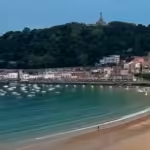
The Igeldo Funicular links the Ondarreta area with the summit of Mount Igeldo, making the ascent part of the visit. Opened on 25 August 1912, it retains its wooden cars and remains one of San Sebastián’s best-known historic transport links. This guide explains how it was built and how the railway works, then sets out what to check before travelling so you are not relying on outdated times or fares.

At Descubre Donostia, we believe that to truly know the soul of the city, you must experience its icons. And today, we invite you to do just that: to feel the gentle rattle of the wooden carriage, to watch as La Concha Bay majestically unfolds at your feet, and to understand why this great little journey is one of the most authentic and beloved experiences for both locals and visitors. Fasten your historical seatbelts, we’re taking off for the summit!
A journey to the Belle Époque: the funicular’s origins
To understand the funicular’s raison d’être, we must immerse ourselves in the San Sebastián of the early 20th century. The city was living its Belle Époque, an era of splendor in which it had established itself as Europe’s most elegant summer resort.
San Sebastián, the drawing room of Europe
Queen Regent María Cristina had established her summer residence here, attracting the entire court, aristocracy, and the high society of Spain and Europe. The beaches filled with bathers in elegant swimwear, the Grand Casino (now the City Hall) was the epicenter of social life, and strolls along Alderdi Eder were a parade of glamour. In this hotbed of luxury and leisure, ambition and grand ideas were the order of the day.
The vision of the Monte Igueldo Society
The funicular was built to connect the city with the restaurant and casino then operating on the summit. It opened on 25 August 1912 in the presence of Queen María Cristina. The Basque Government decree that later protected the site as a Monument Complex credits engineer Emilio Huici with the design, Severiano Goñi with directing the works, and the Swiss company Von Roll Fonderie de Berne with equipping the line. Its story is therefore part of San Sebastián’s early twentieth-century tourism as well as its transport history. The Basque Government’s Decree 84/2014 records the historical and technical details.
The Swiss engineering that connected the city with the summit
With bridle paths dismissed, the answer came from the Alps. The decision was made to build a funicular, and for this, the prestigious Swiss firm Von Roll, a world leader in this type of cable transport, was hired. Under the direction of Spanish engineer Emilio Huici, the construction was a remarkable feat. On August 25, 1912, the Igeldo Funicular made its inaugural journey, becoming the perfect access to San Sebastián’s new entertainment watchtower.
About the video: the scene below is an AI-generated recreation, not historical footage. Its caption is in Spanish.
@descubredonostia.com Recreacion funicular de Igeldo 🕰️✨ ¿Y si pudieras viajar a 1912? ✨🕰️ Hemos usado la IA para recrear esta estampa de los inicios de nuestro icónico Funicular de Igueldo. ¡El resultado es pura magia! 🚂 Este tesoro de madera lleva más de un siglo regalándonos las mejores vistas de San Sebastián, pero… ¿conoces la increíble historia de su construcción en la Belle Époque? ¿O los secretos que esconde su traqueteo? Hemos escrito la guía MÁS COMPLETA que encontrarás sobre él. ¡Una lectura obligada para cualquier amante de Donostia! 📝 Descúbrelo todo en nuestra web www.descubredonostia.com #FunicularIgueldo #Donostia #SanSebastian #MonteIgueldo #DescubreDonostia #BelleEpoque #ViajeEnElTiempo #HistoriaViva #PaísVasco #TurismoEuskadi #AIart #RecreacionHistorica
♬ Spectacular – MoodMode
How it works: the mechanical heart of Igeldo
Part of its immense charm lies in the fact that its fundamental technology has barely changed. It is a masterpiece of mechanical efficiency that has passed the toughest test: the test of time.
The straight track is 312 metres long, and its two cars are linked by a haulage cable driven by machinery in the upper station. Passenger weight does not power the other car: a motor turns a pulley, which moves the cable. Halfway along the line, the track divides so the cars can pass. The Abt system uses differently configured wheels to keep each car on its own side without moving switch points. This is one of the railway’s most interesting engineering features. The 2014 heritage decree gives 39 mm as the diameter of the original traction cable; that is a historical specification, not confirmation of the cable currently in service. The official technical inventory describes the route and mechanism.
In 2014, the Basque Government designated the funicular and park a protected Cultural Asset, a Monument Complex. The protection covers the route, machinery, vehicles, buildings and their setting—not only the appearance of the wooden cars. The funicular remains a working transport link within a historic industrial site. The operator’s current funicular page explains its role in reaching the summit today.
The journey, lasting about three minutes, is a sensory experience. The sound of the cable sliding through the pulleys, the characteristic rattle of the wheels on the rails, and the gentle creak of the original wood transport you to another era.
Planning your Igeldo Funicular ride
Planning your adventure is easy. Here are all the details so your only worry will be choosing the best filter for your photos.
Getting to the lower station
The lower station is located in Plaza del Funicular, at the far end of Ondarreta Beach.
- On foot: The lower station is in the Ondarreta and Wind Comb area. Walking time depends on your starting point and route.
- By bus: Dbus route 16 connects Boulevard with Igeldo. Check the official route 16 timetable for stops, service times and the last departures on your visit date; the timetable is published in Spanish.
- By car or on foot: The operator lists road access and free parking at the summit. Check any site-entry charge and current conditions on the official visit-planning page before setting out. Parking can be limited on busy days.
Timetables, tickets and prices
- Opening times: The operator publishes date-specific hours for the grounds and viewpoint, funicular and rides; these do not necessarily share the same schedule. Select your visit date on the official website and check the last departure before going up.
- Tickets and fares: On 26 September 2026, the official page listed a return ticket at €5.50 for adults and €2.50 for children up to age 7; single fares were €4 and €1.50. The funicular ticket includes entry to the grounds, while rides are charged separately. Fares can change, so check the current price before travelling.
- Rain: The park says its rides close on rainy days. Check the funicular and grounds separately on the official page before making the trip.
Expert Tip: Essential! Before you go, always check the official visit-planning page. It is the most reliable source for the day’s schedule, which can be altered by bad weather or events.
When to go: choosing the best time for your visit
- For photographers: Sunset. The “golden hour” bathes the bay in magical light. Watching the sun sink into the sea from here is, quite simply, unforgettable.
- To avoid crowds: First thing in the morning. You’ll enjoy the ride and the views with more tranquility.
- For a different experience: On a stormy day. Watching the furious Cantabrian Sea crash against the coast from the safety of the summit is a breathtaking natural spectacle.
What awaits you at the top: more than a view
Going up Mount Igueldo is opening a door to a world of fun and panoramas.
- The amusement park: The site retains the character of a historic park. The Swiss Mountain is a distinctive coaster: the heritage decree describes its articulated wooden cars and a reinforced-concrete structure with tunnels and viaducts. The Mysterious River and Labyrinth are among its other classic attractions. The available rides and opening times can change, so check the official list for your visit date.
- The Torreón (Tower): This wooden tower, which served as a lighthouse in the 18th century, offers the most spectacular 360º views. For a small fee, you can climb it and gaze not only at the city but at the entire Gipuzkoan coast.
- Gastronomy: There are several options, from a bar with a spectacular terrace for an aperitif to a hotel-restaurant for a more formal meal.
For the wider visit—park, viewpoints, transport and access—read our complete Mount Igueldo guide.
Stories and details of a century-old funicular
- A historic line: The 2014 heritage decree described it as the oldest funicular in the Basque Country and the third oldest in Spain, after Barcelona’s Tibidabo and Vallvidrera lines, whose installations had already been modified. The heritage decree explains why the railway forms part of a protected industrial site.
- A journey in a time capsule: The carriages retain their original 1912 wooden bodywork. Every crack and piece of metal polished by use tells a story.
- A cinema icon: Its photogenic aesthetic has captivated film directors. The funicular and the park were key locations in Woody Allen’s film “Rifkin’s Festival” (2020), a tribute from the director to the city itself and its Film Festival.
A ride through history, with a view of San Sebastián
The Igeldo Funicular is not just a tourist attraction. It is the guardian of the memory of an era, a symbol of San Sebastián’s love for its landscape, and a fulfilled promise of wonder. It is proof that, sometimes, the journey is as spectacular as the destination. Don’t just look at the photo of La Concha from above; live the complete experience of ascending in this wonderful time machine.
So, have you ridden the Igeldo Funicular yet? What’s your favorite spot on the summit? Tell us in the comments and share the magic of Donostia!